Update 20 January 2016: I am not longer using this diffuser (I went back to using my own design) but they are still the best commercially available diffuser for the MT-24EX. The only negative things I can say about them is that the front plastic is a little too opaque, and that if you're using the MP-E 65mm above 4x it's difficult to get light on the subject due to the angle between the diffusers and the subject (using the Canon flash mount that comes with the flash). Good light quality "out of the box", and even better if you do a little experimenting.
For many years I struggled to get good light out of Canon's MT-24EX. The flash heads are small, there's really no built in diffuser, and in order to get good diffusion and short flash durations (to help freeze motion) the flash heads need to be as close to the subject as possible. So the trick has always been how to diffuse the MT-24EX in as short a distance as possible when it's practically a bare bulb flash. In the end I resorted to using a combination of diffusion plastics, and I turned my flash into something only Doctor Frankenstein could love.
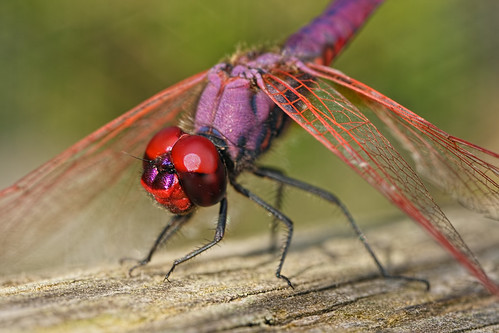
Now there's a new, commercially available, diffuser for the MT-24EX made by Mr. Ian McConnachie available via eBay. They are the best diffusers I've ever used for the MT-24EX in terms of size and diffusion quality, and on a scale of one to Martha Stuart I'd give them a nine. Really well designed! The image I'm including with this post is not an "out of the box" example since I am adding additional diffusion material inside the diffuser, but it does represent a worse case scenario for the MPE-65mm since I'm shooting at life size (the diffusers are at their maximum distance from the subject, and the apperant light size principle is working against me). Even so the diffusion is really good! The specular highlight on the right edge of the dragonfly's eye is normal, and simply due to the angle between the flash head and the subject. You'll notice that there is color and texture behind that specular highlight -it's not completely blown out and that's what you want. At higher magnifications the flash heads get even closer to the subject and the diffusion gets even better.
As an extra added bonus the modeling lights on the MT-24EX are still usable, although the light output is a little reduced because it has to pass through the diffuser. It hasn't been a big deal for me since my own diffuser designs for the MT-24EX have worked in the same way so I'm use to it.
Here's an instruction video by Mr McConnachie showing how to assemble and attach the diffuser:
Disclaimer: I have received no financial compensation for this blog post, not now nor in the future. I'm providing this information solely because I know that there are people out there who are still struggling to get good light out of the MT-24EX...
Update: After I ordered a second set of Ian's diffuser (wanted a set to experiment with) he refunded my money. He didn't have to, and I didn't ask. I like his diffuser so much that I was willing to purchase two sets out of my own pocket. I did, however, pay full price for the set that I reviewed for this post.
Sunday, June 29, 2014
Saturday, June 14, 2014
Tiny Bees Series 1-1 Deconstruction
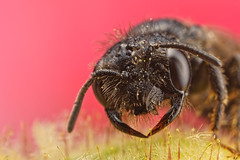
I woke up early, not long after the sun had come up, hoping to find something to photograph. The nighttime temperatures were still pretty low, something that both works for and against me: If I could find a bee then it would probably be pretty lethargic and I could get close. But since the weather was still cool most of the bees are still sleeping underground, and the species that do not sleep in tunnels aren’t out yet.
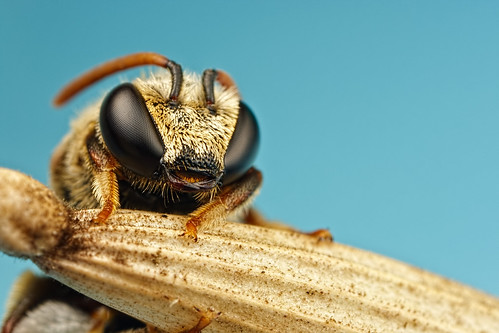
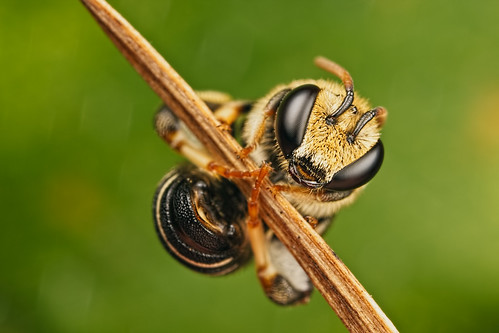
The bee included with this post is a very small species, not more than a few millimeters long. This one had either gone to sleep on a flower (males will sleep in the areas that they are patrolling for mates), or its metabolism had dropped for some reason and it couldn’t find shelter underground. At night the flower closed, trapping the bee inside. When I first spotted it there was just a little head sticking out of the top of that flower and I was hoping to get a much different composition than the one pictured. But when I grabbed the flower’s stem to steady it the bee crawled the rest of the way out. Not to be deterred I spotted a rose nearby that I could use for the background and a few other compositions started popping into my head. I never use a tripod or focusing rail, preferring to shoot hand held because it’s a lot faster than messing with the dials on a focusing rail (once I built up the muscle memory for it). While holding onto the stem of the flower with my left hand I rest the lens on that same hand so that both subject and camera are on the same “platform”. I set the focus my sliding the lens on my hand, and I can make adjustments to the angle of the subject just by rotating the stem between my thumb and index finger. Sounds tricky and it is, but once you get used to it it’s actually an easy way to shoot macro at high magnification.
I chose a low angle because I like shooting insects in much the same way that a portrait photographer photographs a model. You wouldn’t take a shot of the top of someone’s head, and taking a shot with an “I’m about to step on it” perspective is really boring. I focused on the bee’s mandible, and then “rolled” the camera slightly toward the top right corner of the frame so that the area of acceptable focus would cover as much of the bee’s face as possible. I’m not a detail junky, so taking a single frame at five times life size and F11 gives me a good balance between depth of field and detail.
Backgrounds are important in any image, and when dealing with flash falloff it’s really important to have something close behind the subject to reflect light back into the camera. Fortunately the flower the bee was on was close to a dark pink rose and I was able to use it to keep the background from being black. Also notice that the background color isn’t even. Here again I’m borrowing a compositional concept from another photographic discipline, but this time it’s landscape photography. When shooting a landscape you really want partly cloudy skies. A clear sky will make the scene look flat because the background color will be even, and clouds add a lot of depth because they break up that background. Likewise here since I’ve positioned the bee in front of an area where the color isn’t even the image has a lot more depth –it looks more three dimensional. Of course the way that I’m positioning the flash heads, one used as a key and the other as a fill, also helps because the light on the subject isn’t dead even.
Footnote: Why did I go into such detail on this particular deconstruction? Because I’m getting too many emails and private messages from people who have seen my work, went out and bought the same gear, and they are getting frustrated because they can’t get the same results. Having enough disposable income for a high end DSLR, macro lens, and dedicated macro flash is not an “I win button”. There’s so much more to a good photo than just the equipment that was used to take it it’s not even remotely funny. Macro is probably one of the most demanding photographic disciplines and if you don’t have a lot of patience or you’re not willing to take the time to learn how to photograph the small world then you need to consider doing something else. Walking on a tight rope looks easy until you’re the one putting your feet on the rope…
The bee included with this post is a very small species, not more than a few millimeters long. This one had either gone to sleep on a flower (males will sleep in the areas that they are patrolling for mates), or its metabolism had dropped for some reason and it couldn’t find shelter underground. At night the flower closed, trapping the bee inside. When I first spotted it there was just a little head sticking out of the top of that flower and I was hoping to get a much different composition than the one pictured. But when I grabbed the flower’s stem to steady it the bee crawled the rest of the way out. Not to be deterred I spotted a rose nearby that I could use for the background and a few other compositions started popping into my head. I never use a tripod or focusing rail, preferring to shoot hand held because it’s a lot faster than messing with the dials on a focusing rail (once I built up the muscle memory for it). While holding onto the stem of the flower with my left hand I rest the lens on that same hand so that both subject and camera are on the same “platform”. I set the focus my sliding the lens on my hand, and I can make adjustments to the angle of the subject just by rotating the stem between my thumb and index finger. Sounds tricky and it is, but once you get used to it it’s actually an easy way to shoot macro at high magnification.
I chose a low angle because I like shooting insects in much the same way that a portrait photographer photographs a model. You wouldn’t take a shot of the top of someone’s head, and taking a shot with an “I’m about to step on it” perspective is really boring. I focused on the bee’s mandible, and then “rolled” the camera slightly toward the top right corner of the frame so that the area of acceptable focus would cover as much of the bee’s face as possible. I’m not a detail junky, so taking a single frame at five times life size and F11 gives me a good balance between depth of field and detail.
Backgrounds are important in any image, and when dealing with flash falloff it’s really important to have something close behind the subject to reflect light back into the camera. Fortunately the flower the bee was on was close to a dark pink rose and I was able to use it to keep the background from being black. Also notice that the background color isn’t even. Here again I’m borrowing a compositional concept from another photographic discipline, but this time it’s landscape photography. When shooting a landscape you really want partly cloudy skies. A clear sky will make the scene look flat because the background color will be even, and clouds add a lot of depth because they break up that background. Likewise here since I’ve positioned the bee in front of an area where the color isn’t even the image has a lot more depth –it looks more three dimensional. Of course the way that I’m positioning the flash heads, one used as a key and the other as a fill, also helps because the light on the subject isn’t dead even.
Footnote: Why did I go into such detail on this particular deconstruction? Because I’m getting too many emails and private messages from people who have seen my work, went out and bought the same gear, and they are getting frustrated because they can’t get the same results. Having enough disposable income for a high end DSLR, macro lens, and dedicated macro flash is not an “I win button”. There’s so much more to a good photo than just the equipment that was used to take it it’s not even remotely funny. Macro is probably one of the most demanding photographic disciplines and if you don’t have a lot of patience or you’re not willing to take the time to learn how to photograph the small world then you need to consider doing something else. Walking on a tight rope looks easy until you’re the one putting your feet on the rope…
Sunday, February 23, 2014
Reversing the Publishing Scam
Back in December of 2009 I wrote about the Photography 401 Scam and how publishers try to get you to give up your photos for free. A pro photographer in Boston came up with an interesting twist in this Craigslist add:
"I am looking to hire all types of people to do all sorts of jobs for me, as long as I do not have to pay anything. Just think, you will gain more experience, and I will put the word out for you and let everyone know what wonderful work you do. This opportunity will bring you a ton of unpaid work, but everyone will love you. So if you have a job or service you provide, and will do it for free, please let me know, because I am sure I have work for you and will hire you in a second."
Why not -everyone expects him to give his work away! :)
A publisher telling you that they don't have a budget for images makes as much sense as a restaurant that doesn't have a budget for food, so stop giving your photos away for nothing more than a photo credit...
"I am looking to hire all types of people to do all sorts of jobs for me, as long as I do not have to pay anything. Just think, you will gain more experience, and I will put the word out for you and let everyone know what wonderful work you do. This opportunity will bring you a ton of unpaid work, but everyone will love you. So if you have a job or service you provide, and will do it for free, please let me know, because I am sure I have work for you and will hire you in a second."
Why not -everyone expects him to give his work away! :)
A publisher telling you that they don't have a budget for images makes as much sense as a restaurant that doesn't have a budget for food, so stop giving your photos away for nothing more than a photo credit...
Sunday, November 10, 2013
Current Lighting Setup
Current because I'm in this never ending cycle of working on my lighting, compositions, and post processing. So what you see today might not be what I'm using a month from now. I said it in the video, but you really need to experiment with your lighting and not just copy what someone else is doing. If your lighting, and your photographic style, are not unique then your work will never stand out. If you reach a point where you can't compare what you're doing to what everyone else is because your images as so different then you're probably doing something right...
Also you'll have to forgive the pauses in my voice: We have a pair of three month old kittens that waited until I started shooting to begin their version of championship wrestling. Very distracting! :)
Saturday, November 9, 2013
Butterfly Exhibit
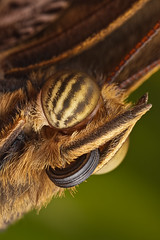
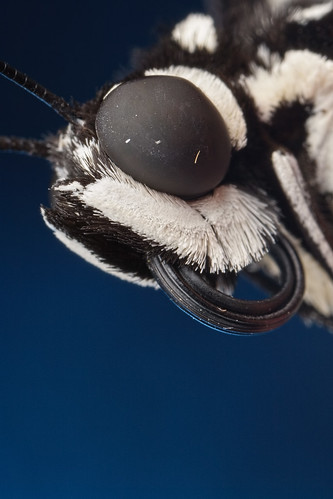
Living in southern Italy has its advantages, but one of the disadvantages for me was no locally accessible butterfly house. I can shoot them in the wild, but getting up close and personal is tough. So I was pretty excited when I saw a flyer announcing an exhibit at the Caste Café, a relatively new coffee bar that had opened up across from the castle in Bacoli (the town where I live). According to the advert the experience would last about an hour and photography was allowed!
There was almost an hour of instruction on the life cycle of a butterfly and about 10 minutes in the exhibit…
Frustrated by not having enough time with the critters, and dealing with curious onlookers who wanted to see what I was doing, I didn’t get too many usable frames. So I sent the image at the top of this post to the curator and told him that I’d be willing to trade prints for greater access to the butterflies. He agreed, and gave me an hour and a half between tours to be alone with the critters.
Sometimes it pays to prostitute yourself :)
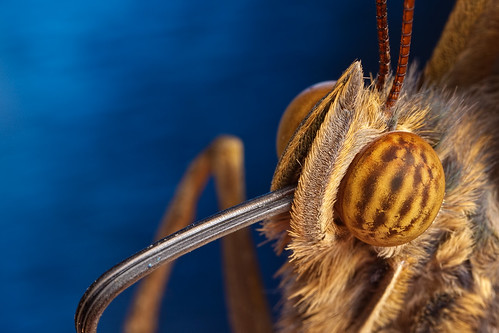
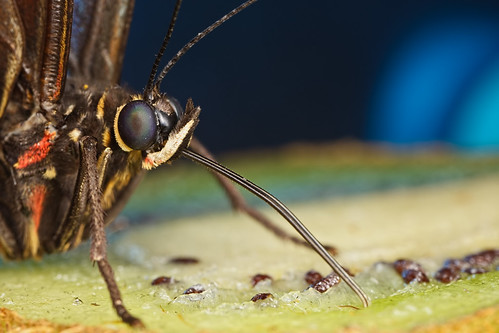
The exhibit consisted of a four meter canvas dome about three meters high that looked just like an igloo, with a chamber at the entrance that separated the dome from the exit to keep the butterflies from escaping. The only natural light inside the dome was provided by some small plastic windows, so I had to rely on the flash to do all the heavy lifting. I tried to take some life size shots of the butterflies feeding, but I just didn’t like the way the backgrounds looked and the color balance between the subject and background was just too far off. So the images that I’ve edited and posted on my gallery have been at twice life size or higher magnification and flash only. For the backgrounds I either held the subject close to a leaf, or used a piece of blue Plexiglas that I keep in my camera bag (I put aluminum foil on the back side of it to act as a reflector). I know quite a few macro photographers that just accept flash falloff as an occupational hazard, and it’s a mistake…

Now for the pros and cons of shooting at a butterfly exhibit:
It was so warm and humid inside the enclosure that I thought I was going to short out my gear by sweating all over it, and after an hour and a half my arms and shoulders were complaining about having to hold about three kilos of camera gear. I love the dynamic range that I’m getting with the 1D MK III, but it wasn’t really meant to be hand held. I’d like to go back to a 1.6x crop factor camera, but I don’t want take a hit in image quality to do it. Canon you desperately need stop adding more pixels to already overcrowded sensors! One other “lesson learned”; at high magnification Kiwi seeds look like poop…

On the bright side the butterflies were pretty much tame. There were a few species that didn’t like me getting close, but for the most part I could shoot at any magnification and working distance that I wanted. When I’m out shooting I frequently get compositions stuck in my head, and working with cooperative subjects was a really good way to get some of those compositions into the camera. It also gave me the opportunity to slow down and look for some unusual angles. I ended up with some pretty unique looking images, and it was definitely worth the effort and the forty euros that I spent on prints for the curator of the exhibit.
There was almost an hour of instruction on the life cycle of a butterfly and about 10 minutes in the exhibit…
Frustrated by not having enough time with the critters, and dealing with curious onlookers who wanted to see what I was doing, I didn’t get too many usable frames. So I sent the image at the top of this post to the curator and told him that I’d be willing to trade prints for greater access to the butterflies. He agreed, and gave me an hour and a half between tours to be alone with the critters.
Sometimes it pays to prostitute yourself :)
The exhibit consisted of a four meter canvas dome about three meters high that looked just like an igloo, with a chamber at the entrance that separated the dome from the exit to keep the butterflies from escaping. The only natural light inside the dome was provided by some small plastic windows, so I had to rely on the flash to do all the heavy lifting. I tried to take some life size shots of the butterflies feeding, but I just didn’t like the way the backgrounds looked and the color balance between the subject and background was just too far off. So the images that I’ve edited and posted on my gallery have been at twice life size or higher magnification and flash only. For the backgrounds I either held the subject close to a leaf, or used a piece of blue Plexiglas that I keep in my camera bag (I put aluminum foil on the back side of it to act as a reflector). I know quite a few macro photographers that just accept flash falloff as an occupational hazard, and it’s a mistake…

Now for the pros and cons of shooting at a butterfly exhibit:
It was so warm and humid inside the enclosure that I thought I was going to short out my gear by sweating all over it, and after an hour and a half my arms and shoulders were complaining about having to hold about three kilos of camera gear. I love the dynamic range that I’m getting with the 1D MK III, but it wasn’t really meant to be hand held. I’d like to go back to a 1.6x crop factor camera, but I don’t want take a hit in image quality to do it. Canon you desperately need stop adding more pixels to already overcrowded sensors! One other “lesson learned”; at high magnification Kiwi seeds look like poop…

On the bright side the butterflies were pretty much tame. There were a few species that didn’t like me getting close, but for the most part I could shoot at any magnification and working distance that I wanted. When I’m out shooting I frequently get compositions stuck in my head, and working with cooperative subjects was a really good way to get some of those compositions into the camera. It also gave me the opportunity to slow down and look for some unusual angles. I ended up with some pretty unique looking images, and it was definitely worth the effort and the forty euros that I spent on prints for the curator of the exhibit.
Saturday, October 19, 2013
Working on Backgrounds
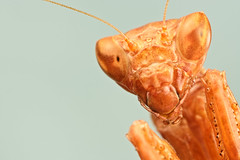
Still experimenting with different materials and techniques. First up is a mantis that I shot in front of a piece of light blue construction paper. II though that since the paper had a matte finish it would make a good background, but oddly enough it looked kind of grey in some of the images that I took. Also notice that the pseudo pupil is almost missing in the critter's left eye -that effect is caused by the way the flash reflects off of the compound eyes (a mantis doesn't really have a pupil). The second flash that I was using to illuminate the background all but washed it out, and what's left is in the wrong position. In the future if I use a second flash when shooting a mantis I'll place it directly behind it.
For this next shot I used a vinyl table cloth, and shooting against a reflective surface works a lot better than shooting against one that has a texture.

There's no natural light in those first two shots, but this next one is a mix of natural light and flash. I set the shutter to 1/20 of a second to expose the reeds in the background, and then let E-TTL metering expose the subject with the flash. This is my preferred method for keeping the background from being black, especially when I can get a good mix of natural light and flash. Even though the sunlight was pretty harsh (taken at about 3PM on a cloudless day) the color and saturation in the background look good because it's out of focus and a little under exposed. A digital sensor reacts to under exposure in the same way as color positive slide film -colors saturate. The downside to this method is that there can be enough natural light to partially expose the subject which makes freezing motion difficult.

I've also noticed that when creating artificial backgrounds that smooth backgrounds do not look as good as ones that have some color or texture variation (especially if the background is not blue). The brain sort of expects vegetation to keep the background from looking smooth. Compare the dragonfly in the previous image with the bee in the next shot -this one is all flash:

For this next shot I used a vinyl table cloth, and shooting against a reflective surface works a lot better than shooting against one that has a texture.

There's no natural light in those first two shots, but this next one is a mix of natural light and flash. I set the shutter to 1/20 of a second to expose the reeds in the background, and then let E-TTL metering expose the subject with the flash. This is my preferred method for keeping the background from being black, especially when I can get a good mix of natural light and flash. Even though the sunlight was pretty harsh (taken at about 3PM on a cloudless day) the color and saturation in the background look good because it's out of focus and a little under exposed. A digital sensor reacts to under exposure in the same way as color positive slide film -colors saturate. The downside to this method is that there can be enough natural light to partially expose the subject which makes freezing motion difficult.

I've also noticed that when creating artificial backgrounds that smooth backgrounds do not look as good as ones that have some color or texture variation (especially if the background is not blue). The brain sort of expects vegetation to keep the background from looking smooth. Compare the dragonfly in the previous image with the bee in the next shot -this one is all flash:

Subscribe to:
Posts (Atom)