Also you'll have to forgive the pauses in my voice: We have a pair of three month old kittens that waited until I started shooting to begin their version of championship wrestling. Very distracting! :)

Sunday, November 10, 2013
Current Lighting Setup
Current because I'm in this never ending cycle of working on my lighting, compositions, and post processing. So what you see today might not be what I'm using a month from now. I said it in the video, but you really need to experiment with your lighting and not just copy what someone else is doing. If your lighting, and your photographic style, are not unique then your work will never stand out. If you reach a point where you can't compare what you're doing to what everyone else is because your images as so different then you're probably doing something right...
Also you'll have to forgive the pauses in my voice: We have a pair of three month old kittens that waited until I started shooting to begin their version of championship wrestling. Very distracting! :)
Also you'll have to forgive the pauses in my voice: We have a pair of three month old kittens that waited until I started shooting to begin their version of championship wrestling. Very distracting! :)


Saturday, November 9, 2013
Butterfly Exhibit
Living in southern Italy has its advantages, but one of the disadvantages for me was no locally accessible butterfly house. I can shoot them in the wild, but getting up close and personal is tough. So I was pretty excited when I saw a flyer announcing an exhibit at the Caste Café, a relatively new coffee bar that had opened up across from the castle in Bacoli (the town where I live). According to the advert the experience would last about an hour and photography was allowed!
There was almost an hour of instruction on the life cycle of a butterfly and about 10 minutes in the exhibit…
Frustrated by not having enough time with the critters, and dealing with curious onlookers who wanted to see what I was doing, I didn’t get too many usable frames. So I sent the image at the top of this post to the curator and told him that I’d be willing to trade prints for greater access to the butterflies. He agreed, and gave me an hour and a half between tours to be alone with the critters.
Sometimes it pays to prostitute yourself :)
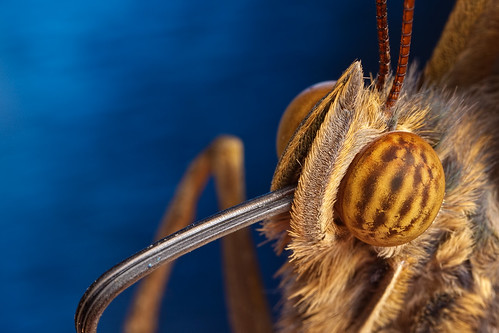
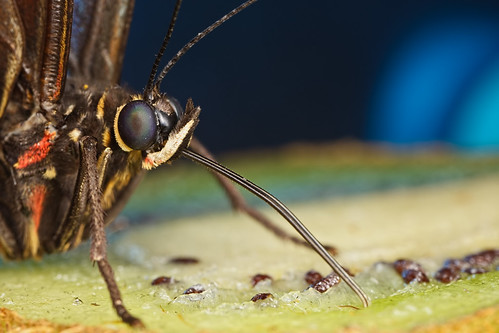
The exhibit consisted of a four meter canvas dome about three meters high that looked just like an igloo, with a chamber at the entrance that separated the dome from the exit to keep the butterflies from escaping. The only natural light inside the dome was provided by some small plastic windows, so I had to rely on the flash to do all the heavy lifting. I tried to take some life size shots of the butterflies feeding, but I just didn’t like the way the backgrounds looked and the color balance between the subject and background was just too far off. So the images that I’ve edited and posted on my gallery have been at twice life size or higher magnification and flash only. For the backgrounds I either held the subject close to a leaf, or used a piece of blue Plexiglas that I keep in my camera bag (I put aluminum foil on the back side of it to act as a reflector). I know quite a few macro photographers that just accept flash falloff as an occupational hazard, and it’s a mistake…
Now for the pros and cons of shooting at a butterfly exhibit:
It was so warm and humid inside the enclosure that I thought I was going to short out my gear by sweating all over it, and after an hour and a half my arms and shoulders were complaining about having to hold about three kilos of camera gear. I love the dynamic range that I’m getting with the 1D MK III, but it wasn’t really meant to be hand held. I’d like to go back to a 1.6x crop factor camera, but I don’t want take a hit in image quality to do it. Canon you desperately need stop adding more pixels to already overcrowded sensors! One other “lesson learned”; at high magnification Kiwi seeds look like poop…
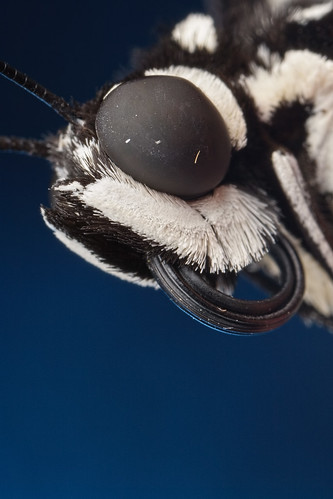
On the bright side the butterflies were pretty much tame. There were a few species that didn’t like me getting close, but for the most part I could shoot at any magnification and working distance that I wanted. When I’m out shooting I frequently get compositions stuck in my head, and working with cooperative subjects was a really good way to get some of those compositions into the camera. It also gave me the opportunity to slow down and look for some unusual angles. I ended up with some pretty unique looking images, and it was definitely worth the effort and the forty euros that I spent on prints for the curator of the exhibit.
There was almost an hour of instruction on the life cycle of a butterfly and about 10 minutes in the exhibit…
Frustrated by not having enough time with the critters, and dealing with curious onlookers who wanted to see what I was doing, I didn’t get too many usable frames. So I sent the image at the top of this post to the curator and told him that I’d be willing to trade prints for greater access to the butterflies. He agreed, and gave me an hour and a half between tours to be alone with the critters.
Sometimes it pays to prostitute yourself :)
The exhibit consisted of a four meter canvas dome about three meters high that looked just like an igloo, with a chamber at the entrance that separated the dome from the exit to keep the butterflies from escaping. The only natural light inside the dome was provided by some small plastic windows, so I had to rely on the flash to do all the heavy lifting. I tried to take some life size shots of the butterflies feeding, but I just didn’t like the way the backgrounds looked and the color balance between the subject and background was just too far off. So the images that I’ve edited and posted on my gallery have been at twice life size or higher magnification and flash only. For the backgrounds I either held the subject close to a leaf, or used a piece of blue Plexiglas that I keep in my camera bag (I put aluminum foil on the back side of it to act as a reflector). I know quite a few macro photographers that just accept flash falloff as an occupational hazard, and it’s a mistake…
Now for the pros and cons of shooting at a butterfly exhibit:
It was so warm and humid inside the enclosure that I thought I was going to short out my gear by sweating all over it, and after an hour and a half my arms and shoulders were complaining about having to hold about three kilos of camera gear. I love the dynamic range that I’m getting with the 1D MK III, but it wasn’t really meant to be hand held. I’d like to go back to a 1.6x crop factor camera, but I don’t want take a hit in image quality to do it. Canon you desperately need stop adding more pixels to already overcrowded sensors! One other “lesson learned”; at high magnification Kiwi seeds look like poop…
On the bright side the butterflies were pretty much tame. There were a few species that didn’t like me getting close, but for the most part I could shoot at any magnification and working distance that I wanted. When I’m out shooting I frequently get compositions stuck in my head, and working with cooperative subjects was a really good way to get some of those compositions into the camera. It also gave me the opportunity to slow down and look for some unusual angles. I ended up with some pretty unique looking images, and it was definitely worth the effort and the forty euros that I spent on prints for the curator of the exhibit.
Saturday, October 19, 2013
Working on Backgrounds
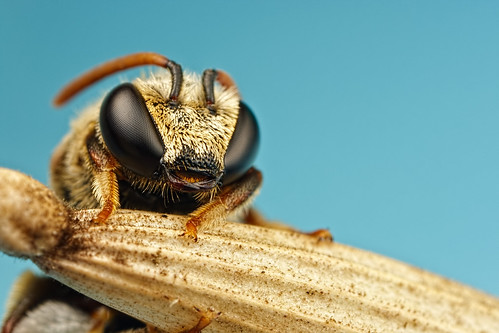
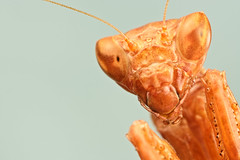
Still experimenting with different materials and techniques. First up is a mantis that I shot in front of a piece of light blue construction paper. II though that since the paper had a matte finish it would make a good background, but oddly enough it looked kind of grey in some of the images that I took. Also notice that the pseudo pupil is almost missing in the critter's left eye -that effect is caused by the way the flash reflects off of the compound eyes (a mantis doesn't really have a pupil). The second flash that I was using to illuminate the background all but washed it out, and what's left is in the wrong position. In the future if I use a second flash when shooting a mantis I'll place it directly behind it.
For this next shot I used a vinyl table cloth, and shooting against a reflective surface works a lot better than shooting against one that has a texture.
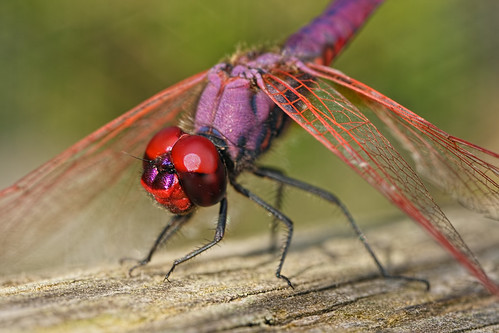
There's no natural light in those first two shots, but this next one is a mix of natural light and flash. I set the shutter to 1/20 of a second to expose the reeds in the background, and then let E-TTL metering expose the subject with the flash. This is my preferred method for keeping the background from being black, especially when I can get a good mix of natural light and flash. Even though the sunlight was pretty harsh (taken at about 3PM on a cloudless day) the color and saturation in the background look good because it's out of focus and a little under exposed. A digital sensor reacts to under exposure in the same way as color positive slide film -colors saturate. The downside to this method is that there can be enough natural light to partially expose the subject which makes freezing motion difficult.
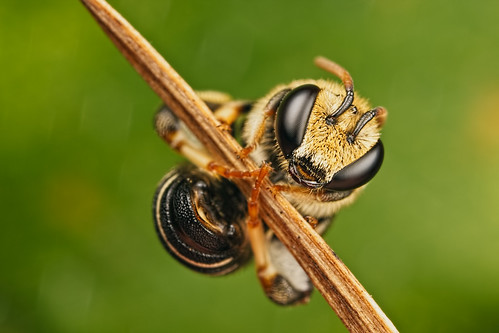
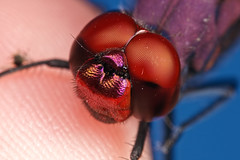
I've also noticed that when creating artificial backgrounds that smooth backgrounds do not look as good as ones that have some color or texture variation (especially if the background is not blue). The brain sort of expects vegetation to keep the background from looking smooth. Compare the dragonfly in the previous image with the bee in the next shot -this one is all flash:
For this next shot I used a vinyl table cloth, and shooting against a reflective surface works a lot better than shooting against one that has a texture.
There's no natural light in those first two shots, but this next one is a mix of natural light and flash. I set the shutter to 1/20 of a second to expose the reeds in the background, and then let E-TTL metering expose the subject with the flash. This is my preferred method for keeping the background from being black, especially when I can get a good mix of natural light and flash. Even though the sunlight was pretty harsh (taken at about 3PM on a cloudless day) the color and saturation in the background look good because it's out of focus and a little under exposed. A digital sensor reacts to under exposure in the same way as color positive slide film -colors saturate. The downside to this method is that there can be enough natural light to partially expose the subject which makes freezing motion difficult.
I've also noticed that when creating artificial backgrounds that smooth backgrounds do not look as good as ones that have some color or texture variation (especially if the background is not blue). The brain sort of expects vegetation to keep the background from looking smooth. Compare the dragonfly in the previous image with the bee in the next shot -this one is all flash:
Tuesday, October 1, 2013
Macro, the 1/f Rule, and Flash Durations
Many, many, moons ago Fred Vachss made a really interesting post over at DP Review concerning the 1/f rule and flash durations as they pertained to macro photography. Basically we were all wondering what shutter speed (or flash duration) was necessary for freezing motion at different magnifications. The mistake that a lot of people made back then was jumping all over the lowest flash duration (flash at minimum power) and claiming that the flash could freeze anything. Unfortunately you'll almost never be shooting with a flash at minimum power, so you'll rarely see those lightning fast bursts of light. The only time I've been able to expose a brightly colored subject at life size magnification and 1/64th power with the MT-24EX is when the flash heads are bare. Not exactly the best light quality... ;)
If you boil Fred's post down here's the 1/f rule for macro photography: Shutter speed = 1/f((1+m)2) where f = focal length of the lens and m = the magnification you're shooting at. So at life size magnification you need a shutter speed that's four times faster than using the same focal length lens for a non macro photo, at twice life size your shutter needs to be six times faster, etc. Substitute flash duration for shutter speed if you're using a flash as the primary, or only, light source. Also keep in mind that the 1/f rule, even modified for macro photography, is a minimum requirement. To "be safe" you'd never want to get close to 1/f rule speeds. Now let's add insult to injury and explain why: Noticeable diffraction is defined as light rays spreading out so that they strike half way into adjacent pixels. The 1/f rule assumes that you're trying to keep the motion in the scene to less than one pixel, and not to less than one half of a pixel. So how easy is it to amplify diffraction with very small amounts of motion, less than the width of half a pixel, while the flash is firing? It's always been my contention that diffraction isn't the monster that most people have made it out to be, and that there is a very synergistic effect between motion and diffraction. You won't necessarily see motion blur in your images but if you're not doing everything you can to minimize movement, and to keep your flash durations as short as possible, you'll have difficulty getting a lot of detail when you shoot at high magnification and high Fstops.
One of these days, just for the focus stacking crowd, I'm going to make a post about how your photos may be diffraction limited even if you're shooting with a lens that's wide open. It has to do with the diffraction limit of green light being four micro meters at F2.8, at the center of a digital sensor (as you move away from the center of the sensor diffraction gets worse). So if your camera has pixels that are four micro meters wide (like the 50D, 60D, and 70D), or smaller (like most of the Power Shot models), you're already recording diffraction at F2.8...
P.S. Not that I have anything against focus stacking -it's just another tool in your tool bag, and some day I might actually stack an image or two. But I do think that a lot of the people who stack their images are actually doing more to defeat macro motion blur than diffraction...
If you boil Fred's post down here's the 1/f rule for macro photography: Shutter speed = 1/f((1+m)2) where f = focal length of the lens and m = the magnification you're shooting at. So at life size magnification you need a shutter speed that's four times faster than using the same focal length lens for a non macro photo, at twice life size your shutter needs to be six times faster, etc. Substitute flash duration for shutter speed if you're using a flash as the primary, or only, light source. Also keep in mind that the 1/f rule, even modified for macro photography, is a minimum requirement. To "be safe" you'd never want to get close to 1/f rule speeds. Now let's add insult to injury and explain why: Noticeable diffraction is defined as light rays spreading out so that they strike half way into adjacent pixels. The 1/f rule assumes that you're trying to keep the motion in the scene to less than one pixel, and not to less than one half of a pixel. So how easy is it to amplify diffraction with very small amounts of motion, less than the width of half a pixel, while the flash is firing? It's always been my contention that diffraction isn't the monster that most people have made it out to be, and that there is a very synergistic effect between motion and diffraction. You won't necessarily see motion blur in your images but if you're not doing everything you can to minimize movement, and to keep your flash durations as short as possible, you'll have difficulty getting a lot of detail when you shoot at high magnification and high Fstops.
One of these days, just for the focus stacking crowd, I'm going to make a post about how your photos may be diffraction limited even if you're shooting with a lens that's wide open. It has to do with the diffraction limit of green light being four micro meters at F2.8, at the center of a digital sensor (as you move away from the center of the sensor diffraction gets worse). So if your camera has pixels that are four micro meters wide (like the 50D, 60D, and 70D), or smaller (like most of the Power Shot models), you're already recording diffraction at F2.8...
P.S. Not that I have anything against focus stacking -it's just another tool in your tool bag, and some day I might actually stack an image or two. But I do think that a lot of the people who stack their images are actually doing more to defeat macro motion blur than diffraction...
Saturday, September 28, 2013
Reminders
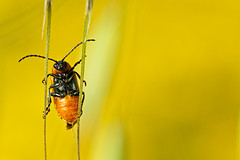
I'm dialing up the way back machine for this image (I took it back in May of 2007). It's a reminder for me of three things: How far I've progressed as a photographer since I took this frame, the need to back off and show my subjects in their surroundings more, and to look around for opportunities to take a shot that I really didn't intend to take. I was chasing a butterfly and not having any luck at all when I turned to my right and saw this beetle that seemed to be watching me chase the butterfly. Could have sworn I heard him laughing... ;)
Friday, September 27, 2013
The Universe Says "No!".
While I was out at the lake testing a new diffuser I noticed that there was something odd going on with the light. At first I blamed the diffuser, but then I realized that my MT-24EX was firing at almost full power, even though I was only shooting around 3x at ISO 100 and F11. Later on that evening I realized what was going on while taking some test images at my kitchen table -the "B" flash head was only firing intermittently.
That's two hardware failures in as many weeks -bummer.
I guess if the gear is going to fail I'd rather it happen now then early next spring. Canon has already given me a repair estimate on my MPE-65mm (about 200 USD) and I sent the MT-24EX to the service center in New Jersey this morning. With any luck I'll have all my toys back in about two weeks. Until then I'm going to explore using a standard camera flash on a bracket.
Sometimes the universe says no... ;)
That's two hardware failures in as many weeks -bummer.
I guess if the gear is going to fail I'd rather it happen now then early next spring. Canon has already given me a repair estimate on my MPE-65mm (about 200 USD) and I sent the MT-24EX to the service center in New Jersey this morning. With any luck I'll have all my toys back in about two weeks. Until then I'm going to explore using a standard camera flash on a bracket.
Sometimes the universe says no... ;)
Tuesday, September 17, 2013
Oops I Did it Again
Not long after I photographed the Weevil to the right my MPE-65mm macro lens started giving me the dreaded "Error 01" message.
Oops...
The least time it happened it set me back about $300 for parts and labor. I'll be sending the MPE back to New Jersey for repairs today. For now it's back to the EF-S 60mm and tubes.

Oops...
The least time it happened it set me back about $300 for parts and labor. I'll be sending the MPE back to New Jersey for repairs today. For now it's back to the EF-S 60mm and tubes.
Subscribe to:
Posts (Atom)